
Textiles & Weaving
Threads of Heritage: Mayan Backstrap Weaving in Guatemala
In the Guatemalan highlands, Mayan backstrap weavers turn cotton into cosmology — and into a quiet political act of refusing to disappear.
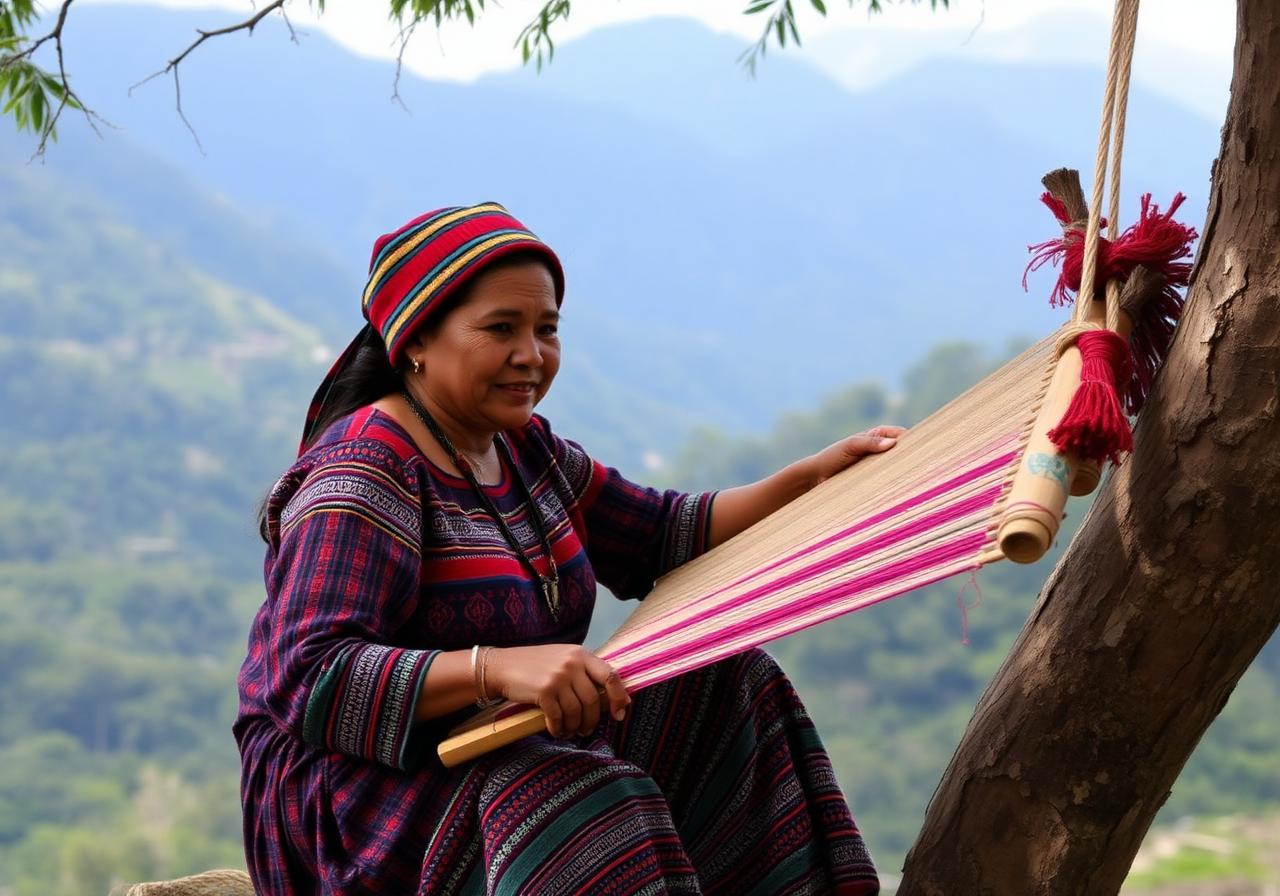
Rosa Tum begins her day at four. By dawn the warp threads are tied to a tree in her yard, the other end strapped around her waist. This is the backstrap loom — telar de cintura — the same technology her grandmother used and her grandmother before her, woven into the highlands of San Antonio Aguas Calientes for at least two millennia.
Backstrap weaving predates the wheel in the Americas. It predates the Spanish, who tried for two centuries to replace it with European foot looms. It predates the Guatemalan state, which during the civil war of 1960–1996 treated weaving in indigenous designs as evidence of subversion. It is still here.
Every huipil — the embroidered blouse Mayan women weave for themselves and for their daughters — tells you where its wearer is from. The diamond at the neckline of Comalapa, the lightning bolts of Sololá, the twin-headed birds of Sacatepéquez, the long horizontal rainbow stripes of Quetzaltenango. These are not decoration. They are geography, theology, and identity stitched into thread, and they are recognisable to other Mayan women at a hundred paces.
Rosa weaves for her family and, increasingly, for the Trama Textiles cooperative in Quetzaltenango, which now represents 400 weavers across 17 highland villages. The cooperative was founded in 1988 by widows of the war, who needed an income that did not require them to leave their land or their children. It now exports to fifteen countries, runs an apprentice school, and has, since 2022, been one of the lead plaintiffs in a long-running legal action to secure collective intellectual property protection for traditional Mayan textile designs.
The legal action matters. In 2016, a major European fashion house released a collection that used Mayan motifs, photographed by white models, with no acknowledgement and no compensation. Trama Textiles, supported by the Mayan rights organisation AFEDES, filed a formal complaint. The case has wound through the Guatemalan courts for nearly ten years; in 2024 a constitutional ruling for the first time recognised collective indigenous authorship of traditional textile designs as a protectable category.
The ruling has not stopped the copying. It has, however, given the cooperatives a tool. Trama now licenses a small number of designs to ethical international brands on the condition that 60% of revenue returns to the weaver collective. The proceeds have funded a Mayan-language primary school, a clinic in Comalapa, and a fund for weavers whose hands have given out.
I sit with Rosa for a full afternoon. She weaves four centimetres in that time — a complex border of zigzags and small geometric birds. Four centimetres. A full huipil takes her between two and six months. The market price in Antigua is roughly 1,500 quetzales — about $200. She would like, she says, for it to be more.
Her granddaughter Esperanza, eight years old, sits beside her with a child-sized backstrap loom. She is weaving a strip the width of two fingers. She has been weaving since she was five. She corrects her grandmother once, gently, on a colour change. Rosa accepts the correction without comment. The thread continues.
Keep reading
 Textiles & Weaving
Isle of Harris, Scotland
Harris Tweed: The Island That Weaves Itself
On the Outer Hebrides, the only fabric in the world protected by an Act of Parliament is still woven on pedal looms in croft sheds. We spent a week with the weavers of Lewis.
 Textiles & Weaving
Pag, Croatia
The Shepherds of Pag and the Lace That Won UNESCO
On a windswept Croatian island where almost nothing grows, women have been making a lace so fine it was once used as currency. UNESCO listed it in 2009. The waiting list is now three years long.
 Textiles & Weaving
Nibutani, Hokkaido
A Quiet Revival on Hokkaido
After more than a century of suppression, Ainu wood and textile traditions are being taught again — in schools, museums, and home looms across the north.