
Ceremonial Masks
The Mask Makers of Mas Village
In Mas, a Topeng mask is consecrated before it is ever worn. The carver fasts, the wood is asked permission, and the first stroke is made on a date the Balinese calendar has been arguing about for a thousand years.
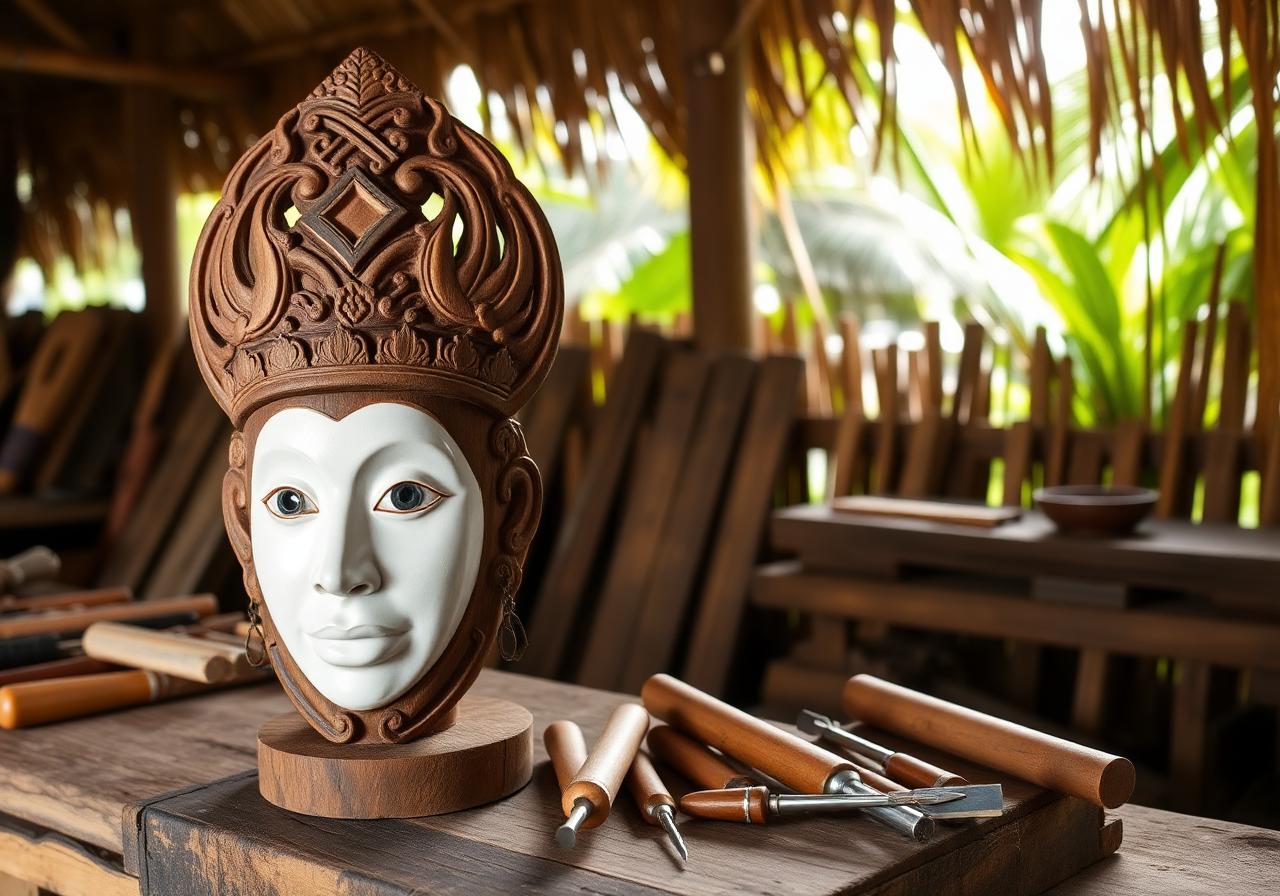
Topeng is dance, theatre and religion at once, and in Mas village, twenty minutes south of Ubud, it has been carved for at least four hundred years. Each mask — the refined Arja, the demonic Barong, the regal Sidha Karya — is made from pule wood, a soft, light hardwood cut only on auspicious days according to the Balinese saka calendar.
I spend a week in the workshop of Ida Bagus Anom, one of the most respected mask-makers of his generation. The workshop is a thatched pavilion open on three sides to the rice fields. There are perhaps thirty masks in various stages on the racks. A finished Sidha Karya — the white-faced "completer of work" mask, the one that closes every ritual performance — is wrapped in white cloth on a small shrine in the corner. It has been there since 2019. It has not been used yet because, Anom says, "the moment has not arrived."
Before the first cut is made, the carver fasts for a day. The block of pule is placed on an altar, an offering of canang sari and a small mantra invites a spirit to inhabit the wood, and the carver asks the tree's permission to release the face that is already inside it. This is not metaphor. Anom does not believe he is designing the mask; he believes he is uncovering it.
The roughing-out takes a week. The final carving — the eyes especially — takes another month. Anom uses thirty-six chisels of varying sizes, all of them made by his father-in-law, who was a blacksmith in Klungkung. The eyes are the last thing to be opened, on a specific day, with a specific tool, and once they are open the mask is no longer an object but a presence.
Anom's son, Wayan, is 31. He trained as a software engineer in Denpasar, worked for three years on Sanur tech start-ups, and came home in 2022 because, he tells me with a slightly embarrassed smile, his father had a dream. "He said the masks were complaining. They needed me. I had to come back."
Wayan now carves four days a week and codes the other three — he has built an inventory and provenance system for the workshop, which sells masks to museums in Tokyo, Berlin, San Francisco, and to a small but serious group of collectors. Every mask leaves with a printed certificate detailing the pule tree it came from, the carver, the consecration date, and the ritual it can be danced in.
On my last evening, Anom dances a fragment of a Topeng performance in the courtyard, holding the mask not over his face but in front of his chest. The transformation is total. The man, the mask, the rice field, the candle. It is the most quietly extraordinary thing I have seen in twenty years of reporting on craft.
He puts the mask down. The mask, for a long moment, looks back.
Keep reading
 Pottery & Ceramics
Évora, Portugal
Alentejo Blue: The Last Azulejo Painters of Évora
In a workshop tucked behind a Roman temple, three women still paint tin-glazed tiles the slow way — and a new generation is finally lining up at the door.
 Wood Carving
Lom, Norway
The Acanthus Revival: Rosemaling in the Norwegian Fjords
Two hundred and sixty years after a wandering painter taught the swirl of European baroque to peasant farmers, a younger generation in Lom is picking up the brush again.
 Textiles & Weaving
Isle of Harris, Scotland
Harris Tweed: The Island That Weaves Itself
On the Outer Hebrides, the only fabric in the world protected by an Act of Parliament is still woven on pedal looms in croft sheds. We spent a week with the weavers of Lewis.