
Folk Paintings
Mithila Painters of Bihar
Women have painted the walls of Madhubani homes for centuries to celebrate marriages and births. Today the same hands hang in the galleries of Tokyo and Berlin.
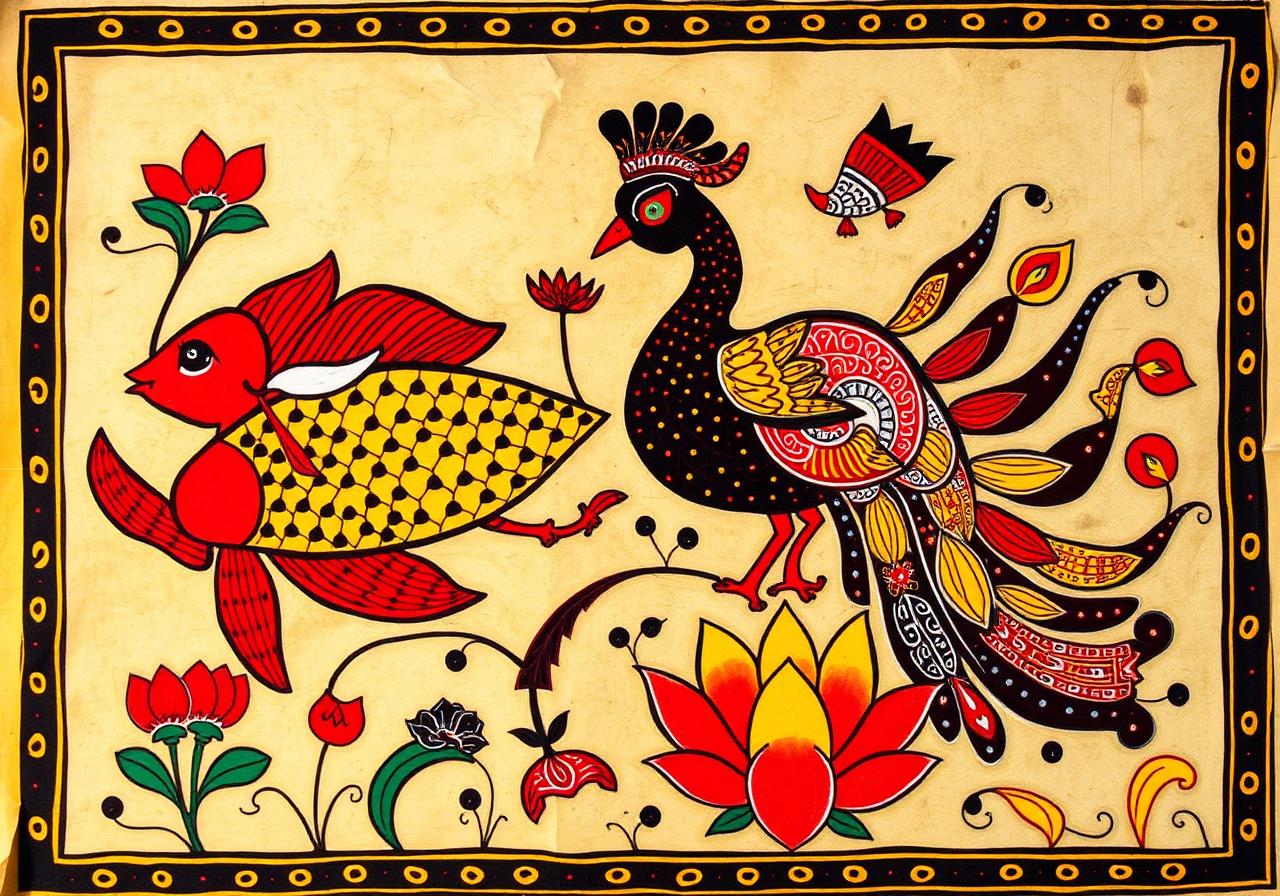
What was once a domestic ritual — paintings made on freshly-mudded walls to celebrate a marriage or a birth — is now one of the most internationally collected folk art forms in India. Mithila painting, also called Madhubani after the district in northern Bihar where it is concentrated, survived a famine in the 1960s when the All India Handicrafts Board encouraged village women to transfer the murals to paper for sale.
What was lost in the translation — the smell of the cowdung-plastered wall, the candle smoke that aged the line over a year — was made up for in reach. By the 1970s, Mithila paintings were in the Mithila Museum in Tokomachi, Japan. By the 1990s, they were in the Smithsonian.
I spend three days in Jitwarpur, the village where the Padma Shri-winning artist Dulari Devi lives and works. Dulari Devi began as a household help in the home of the painter Karpoori Devi, who began teaching her at the age of 12. She now exhibits internationally, has illustrated nine children's books, and runs a workshop in her courtyard with eleven young women apprentices from her own caste — the Mallah, fisherfolk — and three from the Brahmin caste.
The mixing of castes in a Mithila workshop would have been unthinkable two generations ago. The art was traditionally divided: Brahmin women painted the kohbar wedding chambers in the bharni style, full saturated colour, religious symbology, and Mallah and Dusadh women painted the godna style, finer, line-based, drawn from tattoo traditions and almost monochrome. The two styles did not meet.
Dulari Devi's workshop is, deliberately, where they now meet. The students work side by side, and the styles cross-pollinate visibly across the racks. A bharni-style fish in saturated reds and yellows hangs next to a godna-style sun in fine cross-hatched black on a cream ground. They are recognisably the same art form now and recognisably not what they were thirty years ago.
The economics have changed too. A large Mithila painting on handmade paper now sells, in a Delhi gallery, for between ₹40,000 and ₹400,000 — between roughly $500 and $5,000. The village commission rate is significantly less, but a working Mithila artist can now sustain a family without farm labour, which would have been impossible until the 1990s.
On my last morning, Dulari Devi paints a fish for me. She uses a bamboo nib dipped in lamp-black ink. The fish takes her seven minutes. She signs the back. She hands it to me with both hands, the way one hands over something serious.
The fish, in Mithila iconography, is fertility, abundance and water. I take it home to a city where it does not rain enough, and hang it where I can see it from my desk.
Keep reading
 Folk Paintings
Bagheria, Sicily
The Last Cart Painters of Bagheria
Sicilian carretti once carried lemons and wheat across the island in liveries so loud they could be heard before they were seen. Three workshops still paint them — for weddings, films, and a quiet form of memory.
 Folk Paintings
Aubagne, Provence
The Little Saints of Aubagne: Provence's Santon Makers Prepare for Summer
In the red-clay hills behind Marseille, a handful of family ateliers spend the long days of May sculpting the miniature Provençal world — one fisherman, one shepherd, one baker at a time.