
Traditional Jewelry
Andalusian Silver: The Filigree Workshops of Córdoba
A craft brought to Spain by the Phoenicians, refined under the Caliphate, and almost killed by costume jewellery. In Córdoba, a handful of orfebres are still threading silver by hand.
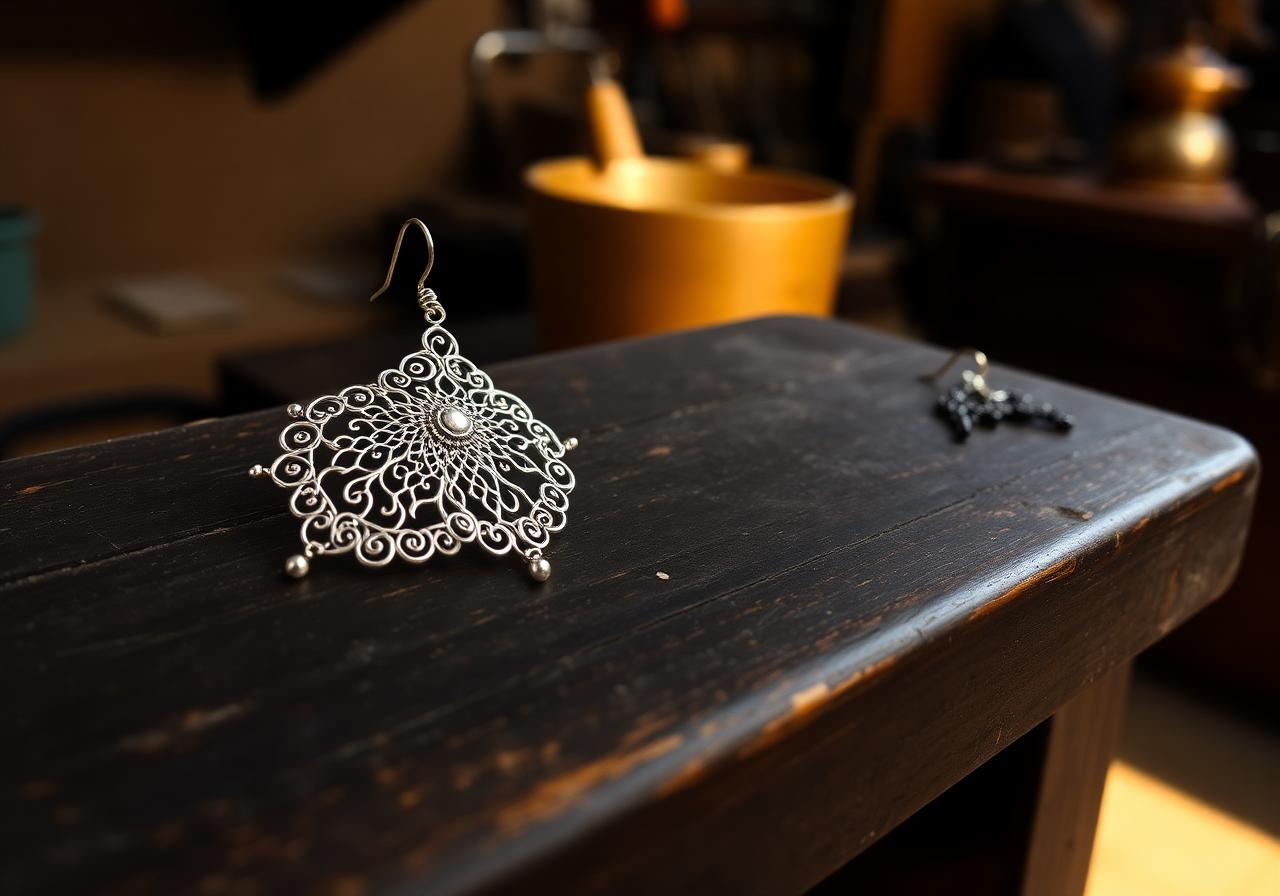
Filigrana cordobesa — Córdoba filigree — is one of the great anomalies of Spanish craft. The technique is straightforward in description and unspeakably difficult in practice: silver is drawn into wire so fine it can be wound around a strand of hair, then coiled, braided and soldered into openwork structures that look like frozen lace. The Phoenicians brought the technique to the Iberian peninsula in the 9th century BC. The Umayyad caliphs refined it in the 10th. And ever since, Córdoba has been the centre.
I meet the brothers Rafael and Antonio Espejo in their workshop on Calle Sevilla, behind the Mezquita. The shop is a single long room. At the back, a brick furnace from 1932 — older than either of them — still heats the borax flux. The brothers, 64 and 61, are the third generation. The fourth, Rafael's daughter Lucía, 28, is sitting at the far bench drawing wire.
Drawing the wire is the part of the craft that almost nobody understands until they see it. An ingot of silver, perhaps the size of a sugar cube, is pulled through a draw-plate of progressively smaller holes — fifty, sixty, seventy passes — until it emerges as wire of 0.2 millimetres. Then it is twisted with a second strand, flattened slightly, and coiled.
A small filigree earring takes Lucía four hours. A wedding tiara took her mother six months and twenty-three thousand individually soldered junctions, which is roughly the population of the village she was born in.
The craft nearly died twice in the last hundred years. The first time was during the Spanish Civil War, when the Espejo workshop was requisitioned to make military buckles and the family hid their wire-drawing tools under floorboards. The second time was in the 1980s, when imported costume jewellery flooded the Andalusian market and a filigree communion cross suddenly cost twenty times what the high-street version cost.
What saved it was, of all things, Andalusian regional pride. In the 1990s, as Spain decentralised and the autonomous communities began funding their own intangible heritage, Córdoba filigree was declared a Bien de Interés Cultural and given a formal apprenticeship route through the regional school of orfebrería. There are now nineteen working filigree workshops in the city, up from six in 1992.
Lucía is the first woman in her family to work the bench. She trained in industrial design in Madrid, came home in 2021, and is now the workshop's de facto designer. Her pieces are not what her father makes — they are sparer, more geometric, occasionally bordering on minimalist. "He calls them naked," she says, laughing. "I call them quiet."
Her father, behind her, snorts but does not disagree. He is bending a coil of silver around a wooden form the size of a thumbnail. He has done this perhaps three hundred thousand times in his life. He still, he says, sometimes gets it wrong.
